Personal Reflection Blog #5/6

It has been a bit over two weeks since I left Ottawa due to university closure for COVID-19. Since then, I have been at my home in Cornwall. It was somewhat overwhelming to get used to the changes this brought to my school work, particularly for this class. A few days after I left, we held another team meeting, and decided what we would do going forward. We came to the conclusion that our project would still be able to be done without using any of the school workshops or labs, so we would keep working on it. Because all my other team-mates live in Ottawa, they were still able to meet and work on the project a few times. I was worried initially that I wouldn’t be able to contribute to the final piece since I am away, and that this would cause tension, but by taking on a larger share of the work that could be done on the computer (project write-ups and teach-a-skill editing), I made up for whatever I couldn’t do in person.

As of now, we have completed the final version of our project. It is set up in one of my teammate’s dining room, on a wall. A few changes were made since I had last seen it: we have now added a light underneath the blobs, and there are vine-like wires connecting them. There are also shapes made of resin now. The sounds have been updated, too. I haven’t heard them yet, but from what I’m aware of, they modified the pitch of sounds to sound higher, lower, and creepier. They also reversed some of the sounds.

Three breathing blobs
New lighting

I had a great time working on this project. At the start, I was unsure of what I’d end up doing in this class, as I don’t have much knowledge of engineering, or making art that actually does things. I’d say that we managed to create exactly what we wanted, though. Our team’s plan was to make something cool, creepy, interactive, moving, and overall not too complicated in theme. The way the piece turned out, I think that we were able to accomplish that.

An interesting part of this process has been navigating the different ways of thinking everyone has in regards to creating a product. While artists are taught to think about what they want to convey, and how to set limits on themselves to express their thoughts, engineers seem to be taught to think about how to work with already-set limitations, and how to create their work with others in mind. There have been a few instances where members of my team have shown these different ways of thinking, and we have had to discuss what would be the best way of moving forward. As this is a combination course, I tried at times to allow myself to think more “like an engineer”, and to worry less about symbolism and emotional connection with this piece. Other times, I would advise my teammates on how an artist is taught to view things, and how it might affect how our work is experienced. For example, at one point one of my engineering classmates suggested making multiple shapes instead of just one, to better display the breathing motion. I ended up explaining that, while it would make the motion more noticeable, changing the scale of the project would also change the way it is being experienced. While it ended up working for our theme, having multiple shapes reads much differently than having only one shape, so we had to think about that before committing to the idea.

For the class itself, the schedule was somewhat daunting. We didn’t end up finding a client because of university closure, but that was definitely the most intimidating part of the course. I would have liked to have had a bit more guidance in terms of what we were meant to do to find a client, or what the exact requirements were, as those were somewhat unclear. I can’t speak for the engineers, but in our art program we have never been taught how to do this, so it was kind of overwhelming. Another thing that wasn’t ideal for me was having class on Fridays, and then having something due on the Sunday, only two days later. While it separated those assignments from the work we’d be doing on weekdays, it meant that our weekend would have to be spent on those projects, leaving us with not much of a break. I also found that having to choose our group and make a group contract within the span of three days were really overwhelming. I was lucky enough to form a team quickly, and to get the emails of everyone so that we could start working, but I think it might have been better if people had a bit more time to get to know each other, or at least not have to start working until the next week. It would have also have been cool to spend less time on lectures, and spend more time doing hands-on work or experiencing interesting things from both fields.

What I did like was when we went to the museum, when we did the LEGO activity, and when we had our group presentations. Having a guest critique our project was very helpful, and seeing the work of other groups allowed us to see the ways people think, and provide suggestions we might not have thought of. The LEGO activity was really fun, and it was something I had never done before. Although it seemed tough at the beginning, I really appreciated that our workload seemed to cool down by the end of the semester, and that the professors were willing to listen to our opinions and suggestions.

I have said this many times before, but the best part of this class had to have been my team. I was really fortunate to have a team where everyone was dedicated to the project, but not so much that they didn’t care about anything else. They were all amazing, funny people who made the experience a great time. If I had another team, even if my project turned out absolutely incredible, I don’t think I would have enjoyed this class as much as I did with my own team. This class has allowed me to make friends with people I probably wouldn’t have under normal circumstances. I learned so many things about engineering, sound design, software, and music too! Every member of my team plays musical instruments, and that was one of the things that brought us all together.

This class has allowed me to have so many fun experiences, and learn so many things that I hope will be useful to me in my art practice moving forward. I am grateful that I had the chance to participate in an inter-disciplinary environment such as this.
Personal Reflection Blog #4

A few weeks ago we got the results of our ITP Metric tests. These are the results:

First, in terms of Collective Team Personality, we placed average for openness, extraversion, emotionality, and conscientiousness, and above average for agreeableness. I think that sounds pretty accurate. When changes have come up during our creative process, no one has ever really protested anything, or questioned whether something should be changed. We all accept the changes that have been made to our project easily.

For the Conflict Management test, I got a 12 for Dominating, 30 for Integrating, 49 for Compromising, 70 for Accommodating, and 84 for Avoiding. When faced with tense situations, I do tend to retreat fairly quickly. I get uncomfortable when dealing with conflict, or having to push my ideas forward, so while I may initially voice an opinion, if I notice that it doesn’t seem to be catching, I’ll stop pursuing it pretty quickly. It’s not as though I won’t voice my opinion if I don’t like something, but that I often don’t find problems with the ideas that other people come up with. Moving forward, I’ll keep in mind that if I ever feel very strongly about part of our project, I should make sure to voice my opinion strongly.

For the Leadership test, I chose dedication and sensitivity to be the most important qualities of a leader. I believe that a leader should lead by example, showing that they are committed to the project and the team, as well as emotionally open to their teammates. These qualities forge a strong bond of trust not only in their work ability, but in their personality.

For myself, I scored high on all the categories, especially so for accurate self view and teachability. My strongest leadership qualities are my ability to provide support and promote teamwork. I got a moderate score for communicating expectations and being a role model. I feel that these are also accurate, at least in my own mind. I like to cheer our team on during our work periods, and care about creating strong bonds and connections with my peers. I believe that once a team has a good dynamic, that will push them to work hard and create an excellent piece on their own.

For the Personality quiz, I ranked low-moderate for Extraversion. Almost all the subheadings in that category were scored low except for assertiveness and cheerfulness. Most of that seemed accurate to me, but I was a bit surprised by the assertiveness score, since I don’t consider myself to be an assertive person. For Emotionality, I scored high-moderate. Other than frustration, which was a low, I ranked pretty high on everything else. Self-consciousness was the highest score. For Conscientiousness, I got a low-moderate, with a low level of self-efficacy, and a high-moderate level of cautiousness. For Agreeableness I got moderate, with low sympathy and a high level of cooperation. And for Openness I got low-moderate, with a low level of intellect, and a somewhat high level of artistic interest and imagination. I think that the personality quiz was also largely accurate. I think of myself as a somewhat emotional person, and it’s true that I don’t care much for abstract theories or concepts. As an artist, it probably would’ve been bad if I didn’t get a good score on artistic interest and imagination. While I don’t believe that I have a low level of sympathy, I think that because I get overwhelmed easily on my own, I don’t have the space to concern myself a lot with the issues of others, so even if I can understand and feel sorry for them, it doesn’t affect me too much. In the future, I will try to use my creative skills in ways that will bring out the best in projects. I will make an effort to consider the feelings of others, while at the same time not getting too caught up in their thoughts to be able to voice my own.

For the Peer Feedback quiz, everyone voted me a lot higher than I did for myself. While I gave myself a 3 in everything other than KSAs (knowledge, skills, and ability), in which I gave myself a 5, they gave me around 5 for everything. I guess that would all be considered a “Blind Spot” then? I’m not sure if this is just a case of me doubting myself, or whether they don’t know me as well as I know myself. Since the personality quiz said that I had a high level of self-consciousness, I’m going to try to view their opinions as somewhat more accurate than mine in this case. If they’ve been working with me all this time and find this to be true, then there must be some truth to it.

As for our Team Dynamics, we have a high level of communication, strategy & planning, and role clarity, with an especially high level of conflict management. Our adaptability and ability to relate are high, and our strongest point is our lack of personal conflict. This holds true to what I have personally noticed and mentioned in previous blogs, as well as what I’ve heard in person from my teammates.

One thing I want to be careful with going forward is making sure that everyone is not just satisfied with our project, but is very happy with it, and feels that they have contributed something big to it’s concept/form. I’ve done this a couple times in previous weekly meetings, but I’m going to ask people in person if they’re absolutely happy with the direction that our project is going in, and if there is anything they believe should be considered/could be changed or added. Especially for members who are quieter, and who aren’t as sure of what is happening, I will try to check in with them, and see if I can help them out with their roles/assignments. Other than that, I’d say we are doing a pretty good job on working together and getting our work done.

Overall, I am extremely happy with my team, and the project we are working on!

Personal Reflection Blog #3

Today marks the end of the 7th week since the start of the new semester. I have attended all 6 STEAM classes, and have met with my team every Wednesday since the second week, excluding this reading week. At this point, I am feeling a lot more confident in terms of what I need to do in this course, and what skills I need to have. Although many of the assignments have seemed to be overwhelming at first, by the time me and my classmates get working on them, they always end up being easier (and a lot less work!) than I thought.

Over the past few weeks, my team members have really warmed up to each other. While the first few meetings were somewhat awkward, we are now able to communicate much more freely and openly. There is no tension or hostility between any of us, and the team dynamic is light and cheerful. In terms of skills, we seem to have identified what each member is most confident in and capable of, and are using this in all of our assignments to determine how to get the best results. In areas where multiple people have similar skills, we allow them to work together, to come up with multiple possibilities. For our Project Deliverables A and B, we divided the work, assigned roles to people ahead of time, and determined a timeline for when things would get done. Project Deliverable C was a bit more shaky, as a lot of members forgot about it because of reading week. As a result, the workloads were slightly more unbalanced than for the other assignments, and not all of the members ended up working on it. That ended up being a bit stressful, especially when we were trying to finish it at the last second, but because the people who didn’t work as much on this assignment have put in a lot more work for our past assignments, I don’t think it’s something that will cause too much tension in the future. My teammates don’t seem to be picky about only doing their assigned portions of work. When one of us is finished with our work, we always offer to help each other.

With regards to our final project, I believe we have made good progress through our weekly meetings. Right now, we are the stage where we have made multiple physical prototypes, as well as a sound prototype, as presented in class. Through the class’s feedback, we have identified which elements of our project they preferred, and which they thought needed some work. For example, they preferred the all-black spray painted model to the unpainted model. We have already made a general plan for what we will all be doing for the rest of the semester to finish the project, as well as what we will work on in our next meeting. As artists, another teammate and I were assigned to be in charge of the project’s visuals. We will be experimenting with fabrics and recyclable materials, trying to mount them on a surface, and making an effort to put together an overall satisfying, creepy-looking model design. I believe we will also be attempting to contact potential clients soon, although I do not know the exact date when that will happen.

For our teach-a-skill section of the semester, I will be teaching my classmates how to use Isadora, a programming software that deals with triggers and interactivity. This software was taught to me in my Lively Objects and Spaces class last semester, so while I do not have an in-depth knowledge of all of it’s aspects, I still have a general awareness of how it works, and what kind of things it can be used for.

As far as the concerns I had in my first blog, I think the communication aspect is still somewhat there. For example, for our Project Deliverable C, when I messaged our teammates about it, only one of them replied back, and started working on it with me. The next day, first one responded, then another started working on it. Eventually the last member finally responded and helped us work on it, but it was only in the last half hour that we were working on it. It is not uncommon for some of my teammates to disappear for long periods of time, and at that point it is almost impossible to contact them. This does not happen often, though, and I think by keeping track of what people are supposed to do, and when they are supposed to do them, we are able to minimize the potential issues this may bring. It is only when unexpected things occur that it can be a bit of an issue. As long as we are on top of our tasks, it doesn’t have too much of an impact, and we can continue to work together with good feelings.

Personal Reflection Blog #2

PART 1 – GENERAL INFORMATION

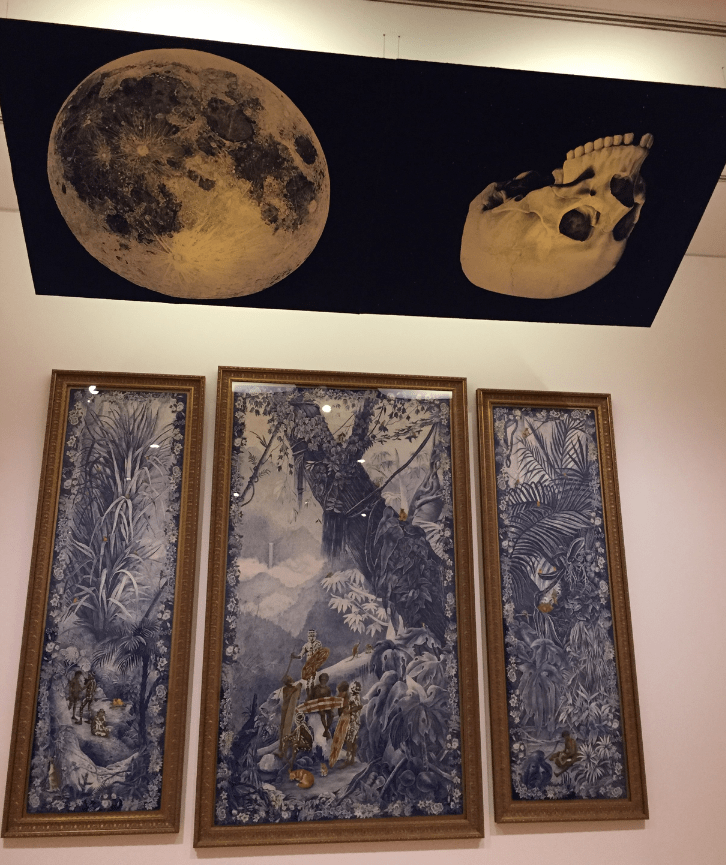
The piece I chose for my formal analysis is Maba-I-Bala Rugy (of Power in Darkness, created by Australian artist Danie Mellor in 2013. It is a framed triptych with an unframed diptych, drawn with pastels, coloured pencils with wash, glitter, and crystal stickers on wove paper. It is very large in size. The triptych is 300 x 374 x 12 cm (framed), and are placed on a wall next to eachother, while the diptych is 153 x 375 cm, and hangs on an angle from the ceiling, directly above (taken from the National Gallery of Canada website). The triptych depicts human figures in large scenes of nature. The people are coloured in natural tones, while the scenery is drawn in blue and white. The diptych is of a large moon and a skull , both about equal in size. This piece is currently on display in the National Gallery of Canada.

Danie Mellor Maba-I-Bala Rugy (of Power in Darkness), 2013. Photo credits to Chantal Rodier, 2020.

PART 2 – BRIEF DESCRIPTION

There are three large drawings depicting Indigenous people in large scenes of nature, and two smaller drawings of a moon and a skull on top of the other three, suspended from the ceiling. Everything in the drawings is a direct representation, as there is a large degree of realism in terms of appearance, with no abstract forms. The people are coloured with warm, natural tones, while the scenery is coloured with blue and white.

PART 3 – FORM

When first looking at this piece, my eyes were drawn to the group of people in the center drawing, because of the large concentration of warm colours contrasting with the cool colours surrounding it. From there, the drawing brings you up the white tree trunk, to the large blue tree, and then to the lone figure on the bottom of the right drawing. After that, my eyes travelled back up the blue tree, to the moon, and then the skull, hanging from the ceiling. From the moon, the large plant at the top of the left drawing brings you down to the figures at the bottom of the left drawing. And from there the white curve at the bottom of that drawing brings you right back to the figures at the bottom of the center drawing.

There are many different forms of line used in this piece. Straight lines exist in the branches, and curved lines exist in the leaves and tree trunks. There are thin lines, and thick lines as well. There are not many completely straight, vertical, horizontal, or diagonal lines, however. The drawings follow nature, and as such, the lines are looser, more natural, and less geometric. In terms of shapes, there are a few different types. The moon and skull are round, while the tree trunks and vines are rectangular. The hills at the back of drawing in the middle are triangular. The rest of the drawings are mostly comprised of looser shapes, like plant leaves and flower petals.

Colour plays a pretty important role in this piece. The human figures, as well as some animals, are drawn with brown, yellow, and red hues. The nature surrounding them is drawn in varying tones of blue and white. The skull and moon drawings are drawn in white, while their backgrounds are black. Because the diptych is hung in front of ceiling lights, it takes on a warm, yellow glow, but when removed from that environment it most likely is a cooler shade of white. There is a large amount of tone and shading in every aspect of this piece, but especially so in it’s depiction of nature. The way it is drawn gives off an impression of texture in the tree bark, but it is all implied. Other than the crystals on the repeating flower pattern borders around the three large drawings, there is no real texture to this piece.

For the drawings on the sides, the scenes exist fairly close to the viewer, whereas in the middle drawing, there is a lot of depth. The drawing extends far out into the background, and is coloured lighter to show distance. For all three, there is lots of overlapping in terms of the plants, which help the drawings to not look as flat. Scale also helps achieve this, as the difference between the large plants and small humans creates a sense of three dimensional space.

In terms of movement, the drawing is fairly static. It is very much a direct representation of reality. It seems like a snapshot of scenes existing in real time. Nothing in this work suggests a distortion of time.

PART 4 – OPINIONS AND CONCLUSION

I believe that the difference in scale, where the nature takes up almost all of the triptych and almost drowns out the human figures in them, represent fantasies of an unknown, “untouched” nature. The artist’s statement explains that the plants and environment are colour blue and white to reflect imperialist ideologies (taken from the National Gallery of Canada website). When relating this to Indigenous people, the idea of an immense, unsullied environment was fairly common among settlers and colonizers. In the triptych, it seems as though the plants in this pictures are scaled-up versions of plants that normally are quite small. This further supports the idea that the non-Indigenous people see nature to be something that it is not. The skull at the top of the piece is an example of memento mori, remembering one’s own mortality. It’s direct parallel to the moon could represent the decay of nature, or perhaps a difference between the mortality of man and the long-lasting existence of nature.

Personal Reflection Blog #1

Today is the day before my third week of the new semester begins. I have attended both of the STEAM classes so far, and one mid-week meeting with the rest of my group. As an art student going into this class, I’ll admit, I’m rather intimidated by the syllabus and class structure. The first class seemed to be filled with concepts I was not familiar with, but was somewhat expected to be. I was really thankful that one of my team members knew what to do for the first assignment, since I didn’t know how to make a group contract and he had already done that kind of thing before. He actually seems to know a lot more about what’s going on than me and some of my classmates do, so we ended up relying on him a lot. We all definitely try to be careful not to rely on him too much though, and make sure we’re pulling our own weight.

It’s already been a really interesting experience having a group with people from such different backgrounds. One one hand, me and one of my team members are friends from the same program. We have done group projects before, and know that we work well together. Having engineering students brings to the table entirely different ways of thinking. For example, during our meeting we were trying to think of what we wanted the overall emotional take-away of our project to be, and one classmate said that as an engineer, he simply wanted something that would look cool. I think that that might be one of the biggest challenges our group is facing right now, where a few of us are used to dealing with emotional works and want our project to be impactful and deep, while the other few are more interested in making an interesting visual concept and creation. It also doesn’t help much that we just had a new member added to our group, and we haven’t been able to have a full group discussion since to understand his ideas.

That might be our other big challenge: communication. As of now we still don’t have one space where we can all message each other. We managed to get all but one member into a group chat, but now some people need to make accounts on something else so we can all talk to each other. But even in this group chat, a lot of the time people will leave and not reply for extremely long intervals. As I type this, I have been waiting for one group member to reply to a message for 3 days. It’s a bit concerning, but I think we can always find a way to make do if some people fall short. At the end of the day, I think that once we figure out what kind of work we want to make and get everyone in one messenger, one of the more difficult parts of the assignment will be done, and we can focus on creating!

On a side note, I had a really cool moment during our mid-week group meeting when we were brainstorming project ideas. As the two engineering students were talking about some ideas and aspects of a project they’d be interested in, some of the things they said really impacted me. I kind of had a realization that they weren’t necessarily just engineers. They were both people who had experience in the artistic world, and had really interesting things to say about it. I’d also say that me and my friend are more into things that some our more traditional “artistic” classmates aren’t (like math). That revelation really inspired me, and is making me appreciate the dynamic we have in our group even more.

Throughout the short time that I’ve been in this class, I have found myself drawing a lot of similarities between this course and the Lively Objects and Spaces (Interactive Media Arts) class I took last semester. They both are interested in discovering ways that art and technology can be combined to make interesting and impactful experiences. It also involved a small group project, and a larger (but optional) group project. The STEAM class is different from that class though, in that we are required to find clients, and go about this project in more of a business-like manner. It definitely feels more professional than the project I did last semester. I’m hoping by the end of the class, that I will have pushed myself out of my comfort zone and have become more experienced in the professional business/artistic world.

As far as skills go for this project, I’m not too sure how much I will be able to contribute, as we have not yet decided what we want our project to be like. I do think that I’m pretty good at figuring out how to do new things, and learning interesting and creative ways to use a little amount of knowledge of technology to do a lot of things. I guess I’ll also be good at designing and creating the project’s visuals.

One of the things I will for sure need to work on is my assertiveness. It’s not that I don’t know how to lead and act with authority, but I find that I’m generally a really laid back person, so I won’t have strong opinions about a lot of things. When I do, it’s hard for me to say that I want to do a specific thing, or that I don’t want to do a specific thing, without beating around the bush. Another thing I sort of struggle with is assigning work to others. In group projects I always like to take on as much work as possible, since I can trust myself to get it done, and because I don’t want to feel like the person that relies too much on other people. I really don’t like feeling like I’m relying on other people. I’d much rather do most of the work myself. For this project, I’m at a disadvantage in terms of skills and experience, so I think for myself, I’ll need to get used to trusting others to get work done, and not feeling bad when people put in a lot of work.

As of now, we don’t know what we want to do our project on. The team was originally formed because I saw three other people who had their second choice as a “Music” project. With our last two additions, I’m not sure how much our team still wants to stick to that idea. We seem to be leaning more towards an art installation, but I think sound is still going to play an important role in the final product. We’re going to meet up again on Wednesday, and I think we’re going to decide for sure what we want to do. Some of my teammates mentioned making a subwoofer, and I think that would be really cool.

I’m really excited to be in this class, and I’m looking forward to working on this project with my team!

– Aishah V.

Design a site like this with WordPress.com
Get started