PART 1 – GENERAL INFORMATION
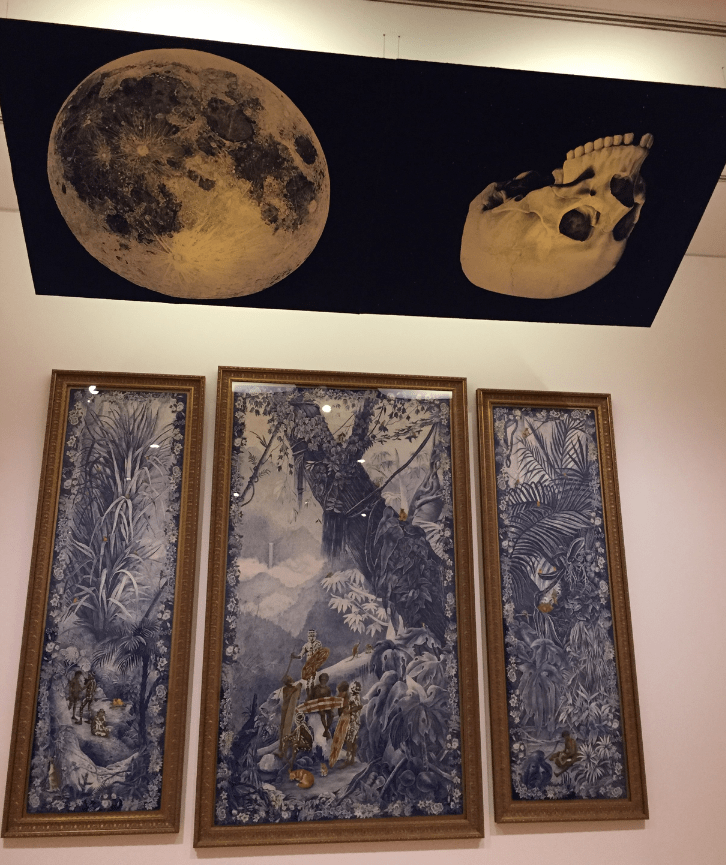
The piece I chose for my formal analysis is Maba-I-Bala Rugy (of Power in Darkness, created by Australian artist Danie Mellor in 2013. It is a framed triptych with an unframed diptych, drawn with pastels, coloured pencils with wash, glitter, and crystal stickers on wove paper. It is very large in size. The triptych is 300 x 374 x 12 cm (framed), and are placed on a wall next to eachother, while the diptych is 153 x 375 cm, and hangs on an angle from the ceiling, directly above (taken from the National Gallery of Canada website). The triptych depicts human figures in large scenes of nature. The people are coloured in natural tones, while the scenery is drawn in blue and white. The diptych is of a large moon and a skull , both about equal in size. This piece is currently on display in the National Gallery of Canada.
PART 2 – BRIEF DESCRIPTION
There are three large drawings depicting Indigenous people in large scenes of nature, and two smaller drawings of a moon and a skull on top of the other three, suspended from the ceiling. Everything in the drawings is a direct representation, as there is a large degree of realism in terms of appearance, with no abstract forms. The people are coloured with warm, natural tones, while the scenery is coloured with blue and white.
PART 3 – FORM
When first looking at this piece, my eyes were drawn to the group of people in the center drawing, because of the large concentration of warm colours contrasting with the cool colours surrounding it. From there, the drawing brings you up the white tree trunk, to the large blue tree, and then to the lone figure on the bottom of the right drawing. After that, my eyes travelled back up the blue tree, to the moon, and then the skull, hanging from the ceiling. From the moon, the large plant at the top of the left drawing brings you down to the figures at the bottom of the left drawing. And from there the white curve at the bottom of that drawing brings you right back to the figures at the bottom of the center drawing.
There are many different forms of line used in this piece. Straight lines exist in the branches, and curved lines exist in the leaves and tree trunks. There are thin lines, and thick lines as well. There are not many completely straight, vertical, horizontal, or diagonal lines, however. The drawings follow nature, and as such, the lines are looser, more natural, and less geometric. In terms of shapes, there are a few different types. The moon and skull are round, while the tree trunks and vines are rectangular. The hills at the back of drawing in the middle are triangular. The rest of the drawings are mostly comprised of looser shapes, like plant leaves and flower petals.
Colour plays a pretty important role in this piece. The human figures, as well as some animals, are drawn with brown, yellow, and red hues. The nature surrounding them is drawn in varying tones of blue and white. The skull and moon drawings are drawn in white, while their backgrounds are black. Because the diptych is hung in front of ceiling lights, it takes on a warm, yellow glow, but when removed from that environment it most likely is a cooler shade of white. There is a large amount of tone and shading in every aspect of this piece, but especially so in it’s depiction of nature. The way it is drawn gives off an impression of texture in the tree bark, but it is all implied. Other than the crystals on the repeating flower pattern borders around the three large drawings, there is no real texture to this piece.
For the drawings on the sides, the scenes exist fairly close to the viewer, whereas in the middle drawing, there is a lot of depth. The drawing extends far out into the background, and is coloured lighter to show distance. For all three, there is lots of overlapping in terms of the plants, which help the drawings to not look as flat. Scale also helps achieve this, as the difference between the large plants and small humans creates a sense of three dimensional space.
In terms of movement, the drawing is fairly static. It is very much a direct representation of reality. It seems like a snapshot of scenes existing in real time. Nothing in this work suggests a distortion of time.
PART 4 – OPINIONS AND CONCLUSION
I believe that the difference in scale, where the nature takes up almost all of the triptych and almost drowns out the human figures in them, represent fantasies of an unknown, “untouched” nature. The artist’s statement explains that the plants and environment are colour blue and white to reflect imperialist ideologies (taken from the National Gallery of Canada website). When relating this to Indigenous people, the idea of an immense, unsullied environment was fairly common among settlers and colonizers. In the triptych, it seems as though the plants in this pictures are scaled-up versions of plants that normally are quite small. This further supports the idea that the non-Indigenous people see nature to be something that it is not. The skull at the top of the piece is an example of memento mori, remembering one’s own mortality. It’s direct parallel to the moon could represent the decay of nature, or perhaps a difference between the mortality of man and the long-lasting existence of nature.
 A Journey Through STEAM